- Home
- News
Over 600 Representatives of Civil Society Attend 9th BRICS Civil Forum in Moscow
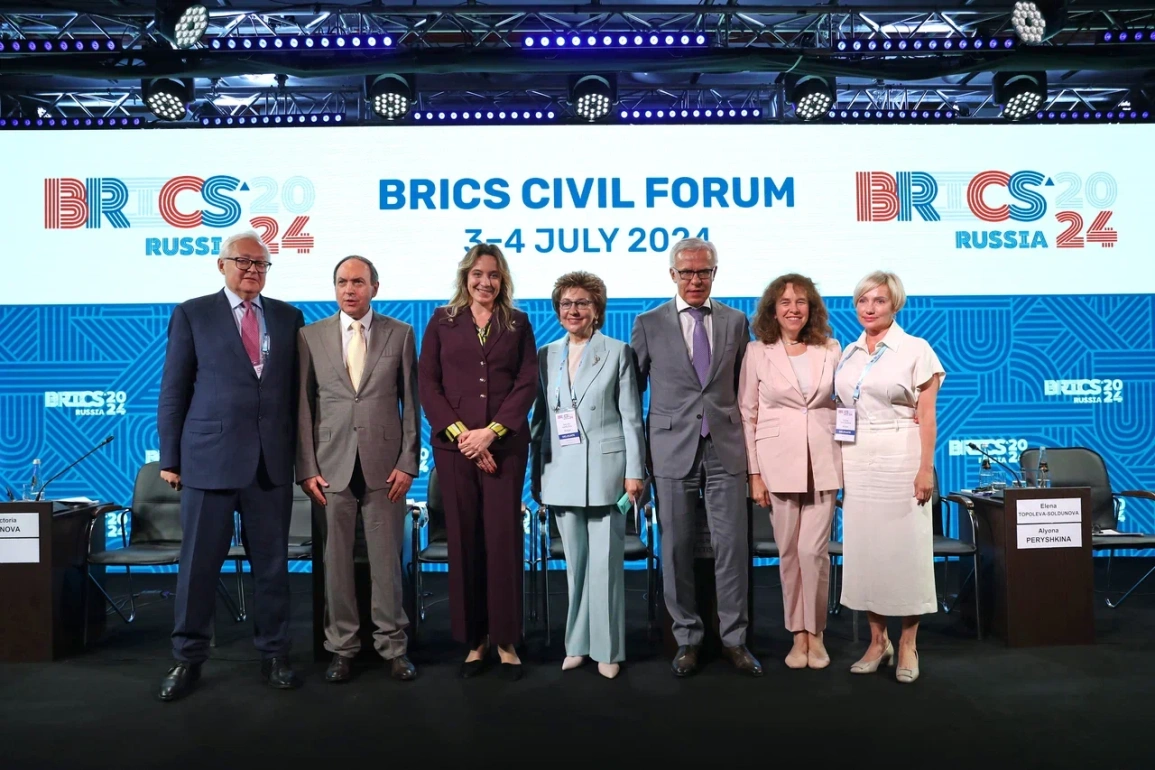
The 9th BRICS Civil Forum took place in Moscow on 3–4 July 2024. The event, which was attended by representatives of new BRICS countries, was organized by the BRICS Expert Council.
Opening the Forum, Viktoria Panova, chairwoman of the BRICS Expert Council, vice-rector of the National Research University Higher School of Economics, and Russia’s sherpa in the Women 20, called for a collective solution to problems associated with sustainable development. “The rapprochement of BRICS countries has led to more contacts not only at the state level, but also at the level of civil society and non-profit organizations, since civil society and its representatives are the ones that must set the basic parameters for equitable development,” Panova said. She also noted that the Forum was attended by more than double the number that was expected: 650 people from 20 countries travelled to Moscow for the Forum. The expansion of BRICS has provided a new impetus to civil dialogue among all ten member countries, she said.
The key goal of the Forum, which this year was held under the motto ‘Strengthening Multilateralism for Just Global Development and Security’, is to formulate ideas for equitable development and find ways to improve the quality of healthcare, education, culture, and sport. “We are working to make the world a more prosperous, equitable, and secure place. This year, we created nine working groups that prepared proposals in different areas. These recommendations will be conveyed to the leaders of BRICS countries for the summit in Kazan,” Panova said. The full version of the speech is available on the BRICS Expert Council’s YouTube channel.
Russian Deputy Minister of Foreign Affairs and Russia’s Sherpa in BRICS Sergey Ryabkov said: “The Civil Forum has become one of the pillars of the association’s architecture and offers an opportunity to present civil initiatives and discuss pressing issues of the member countries and individuals. The civil track is the most vibrant area of the strategic partnership and focuses on the development of humanitarian ties and mutual cultural enrichment.”
Ryabkov noted that the main goal of the association as a whole and the Forum in particular is to create conditions to further develop human potential. “The unique culture of dialogue, the truly trust-based relationships, and respect for the choice of one’s own development have all helped and continue to help find common ground. This format of interaction, without imposing someone else’s values and priorities, should become a model of equitable interstate relations. BRICS is becoming a true spokesman for the interests of the global majority,” he said.
Ryabkov also drew attention to the upcoming UN Summit of the Future in New York, where efforts should be made to build a fair multipolar world order and achieve the Sustainable Development Goals. He noted the importance of formulating common approaches to the safe use of new technologies. In particular, Russia is promoting a code of ethics concerning artificial intelligence that was prepared by Russian experts.
The opening ceremony was also attended by Vyacheslav Nikonov, first deputy chairman of the Russian State Duma’s Committee on International Affairs and chairman of the management board of the National Committee for BRICS Research; Vyacheslav Fetisov, co-chairman of the Ecology, Energy Transition, and Social Justice Working Group and first deputy chairman of the State Duma’s Committee on Ecology, Natural Resources, and Environmental Protection; Galina Karelova, chairwoman of the Council of the Eurasian Women’s Forum under the Federation Council of Russia; Alena Peryshkina, co-chairwoman of the Russian Group of NGOs on BRICS and G20 Issues and director of the AIDS Infosvyaz Foundation; and Yelena Topoleva-Soldunova, director of the Social Information Agency.
The Forum continued with the plenary session ‘The Right to Development: Equality, Equity, and Fairness’, which was attended by GenDev Centre for Research and Innovation Executive Director Govind Kelkar (India), Iranian Red Crescent Society President Pir Hossein Kolivand, TASS News Agency General Director Andrey Kondrashov, Chairman of the Russian Presidential Council for the Development of Civil Society and Human Rights Valery Fadeyev, China NGO Network for International Exchanges Vice President Li Jun, Co-Chairman of the BRICS Information and Digital Security Working Group and Professor of Political Science at the Federal University of Rio Grande do Sul Fabiano Mielniczuk, and CEO of the Hailemariam & Roman Foundation and former first lady of Ethiopia Roman Tesfaye Abneh.
During the plenary session ‘Vision 2050: The Future of the World through the Eyes of BRICS Countries’ on the second day of the Forum, the participants discussed key issues concerning cooperation and the main challenges facing humanity, and proposed ways to solve them. The discussion focused on intensifying interaction in outer space, the use of nature-like technologies to transform the technosphere, overcoming social inequality, and building effective relationships within BRICS based on collective rather than individual interests.
The sessions ‘Information and Digital Security’ and ‘Ethics of New Technologies’ provided an opportunity to discuss a wide range of issues, including ethical standards for the use of digital technologies, the threat of the loss of identity and the decline in the overall cultural level of the general public, the principles of how the information space can function safely, data protection and cybersecurity, laws to protect children and young people against the risks of AI technologies, cryptocurrency, and access to technology.
In the run-up to the Forum, representatives of the BRICS civil community approved the drafts of a number of documents, including: the Manifesto of Civil Society Representatives of the Countries of the Global Majority, which was signed at the Forum (signatures continue to be collected online), as well as a unique document – the Address to the UN Summit of the Future – from the participants of the BRICS Civil Forum. It aims to draw the attention of heads of state and government to the paramount importance of fully realizing people’s right to development in order to build an economically, socially, and environmentally sustainable future for our planet and to protect present and future generations.
For the first time, a philosophical essay competition titled ‘Vision 2050 – BRICS People 2050 – How BRICS Will Change the World by 2050’ was held during the BRICS Civil Forum. The participants were asked to imagine a future that would be better for all humanity and propose long-term measures to make it happen. Representatives from Russia, Brazil, China, India, South Africa, Spain, Uruguay, Turkmenistan, and the Democratic Republic of the Congo took part in the competition. A total of more than 160 applications were submitted. “Based on the results of the meeting, the panel members identified 10 certificate recipients, and three winners had the opportunity to personally attend the BRICS Civil Forum in Moscow. Every participant proposed some sort of solution,” said Felix Azhimov, dean of the Faculty of Humanities at the National Research University Higher School of Economics and chairman of the panel of judges of the philosophical essay competition.
TASS served as the general partner of the event. The Forum included a joint photo exhibition titled ‘Western Globalism in Action’ and the presentation of the report ‘Colonialism 3.0: The Origins and Methods of Modern Western Globalism’.
On 4 July, the traditional press conference to recap the BRICS Civil Forum was held at the Rossiya Segodnya International Information Agency.
The Roscongress Foundation manages the events of Russia’s BRICS Chairship.


