- Home
- News
BRICS Urbanization Forum Participants Discuss Best International Urban Development Practices
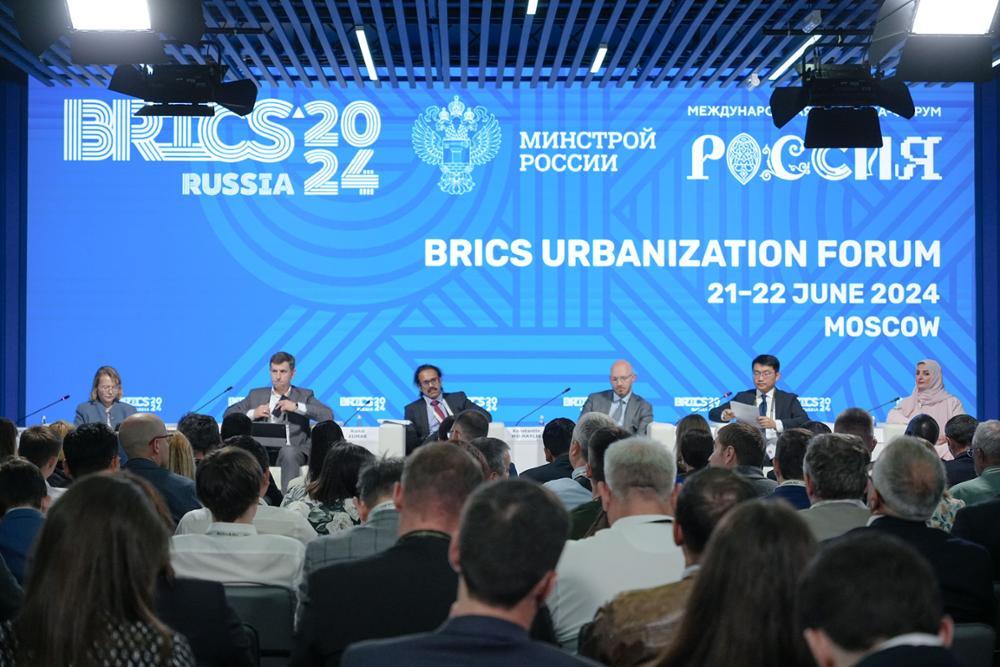
BRICS Urbanization Forum was held at the International RUSSIA EXPO on 21 June 2024. The key event of the Forum was the plenary session ‘Creation of Sustainable Strategies for the Development of the Urban Environment’, during which the participants spoke about ways to optimize urban amenities and best practices for creating a comfortable living environment.
The session was attended by Russian Minister of Construction, Housing, and Utility Services Irek Fayzullin, Brazilian Minister of Cities Jader Barbalho Filho, Ethiopian Minister of Urban and Infrastructure Chaltu Sani, Chinese Deputy Minister of Housing and Urban-Rural Development Qin Haixiang, Joint Secretary of the Indian Ministry of Housing and Urban Affairs Kunal Kumar, and other representatives of foreign countries. They spoke about government improvement programmes in the countries they represent and shared their experiences with colleagues.
“Multifaceted cooperation is built on the basis of equality and mutual respect, as well as the principles of openness, pragmatism, solidarity, and continuity. Held on an annual basis, the traditional BRICS Urbanization Forum has well established itself as a platform for a fruitful exchange of views and best practices,” Fayzullin said.
The Minister spoke about Russia’s experience and the results of the construction industry and the public utilities sector, as well as priority areas of development. In particular, over five years, Russia has commissioned 513.7 million square metres of housing, including 239.6 million square metres of apartment buildings. By 2030, 20% of the country’s housing is scheduled to be renovated.
Fayzullin said Russia is focusing on creating a comfortable urban environment. More than 700 facilities have been renovated as part of a national competition to improve public spaces, he said. By 2030, Russia plans to improve at least 30,000 public spaces and implement at least 1,600 projects in small and historical settlements based on the proposals by the competition winners.
These focuses will be reflected in the new national project ‘Infrastructure for Life’, which is being compiled in accordance with the national development goals outlined by the President of Russian Federation Vladimir Putin.
The Forum programme included several sessions on key issues related to the creation of a comfortable living environment. In particular, during the session ‘Smart City: A Human-Centric Approach to Urbanization’, the participants discussed the development and transformation of cities, as well as the most effective digital solutions, and also exchanged best practices in matters concerning smart cities.
In his speech, Russian Deputy Minister of Construction, Housing, and Utility Services Konstantin Mikhaylik focused on how the use of modern approaches gives industry the opportunity to reduce the time and cost of projects.
During the session ‘Green Construction: Trends and Development Prospects’, the participants discussed ways to increase the energy efficiency of buildings and industrial facilities, which has a positive impact on economic growth.
The participants noted that all BRICS countries are focusing on sustainable development and increasing the energy efficiency of the construction industry and that the development of unified design solutions and the exchange of best practices could help to reduce the industry’s environmental impact. In particular, the experience of China and the UAE in green construction has already been taken into account when developing an interstate green standard for the Eurasian Economic Union. The relevant work is currently being carried out by the Russian Ministry of Construction together with DOM.RF and the Russian Federal Centre for the Regulation, Standardization, and Technical Assessment of Conformity in Construction.
The session also touched upon such issues as achieving national goals, including amendments to existing technical standards concerning the energy efficiency of buildings and structures, creating mechanisms to support the development of housing construction, and reducing the carbon footprint from the operation of housing and utility services facilities and enterprises in the construction industry. In addition, financial incentives for green building programmes and the development of the appropriate state support measures for housing lending were considered.
The traditional BRICS Urbanization Forum is a platform where BRICS countries can exchange best practices and opinions on the development of housing construction and architecture, the creation of a comfortable urban environment, urban planning, and specialized education.
The Roscongress Foundation manages the events of Russia’s BRICS Chairship.


