- Home
- News
Experts Discuss BRICS Cooperation to Provide Fundamental Data on Space and Time
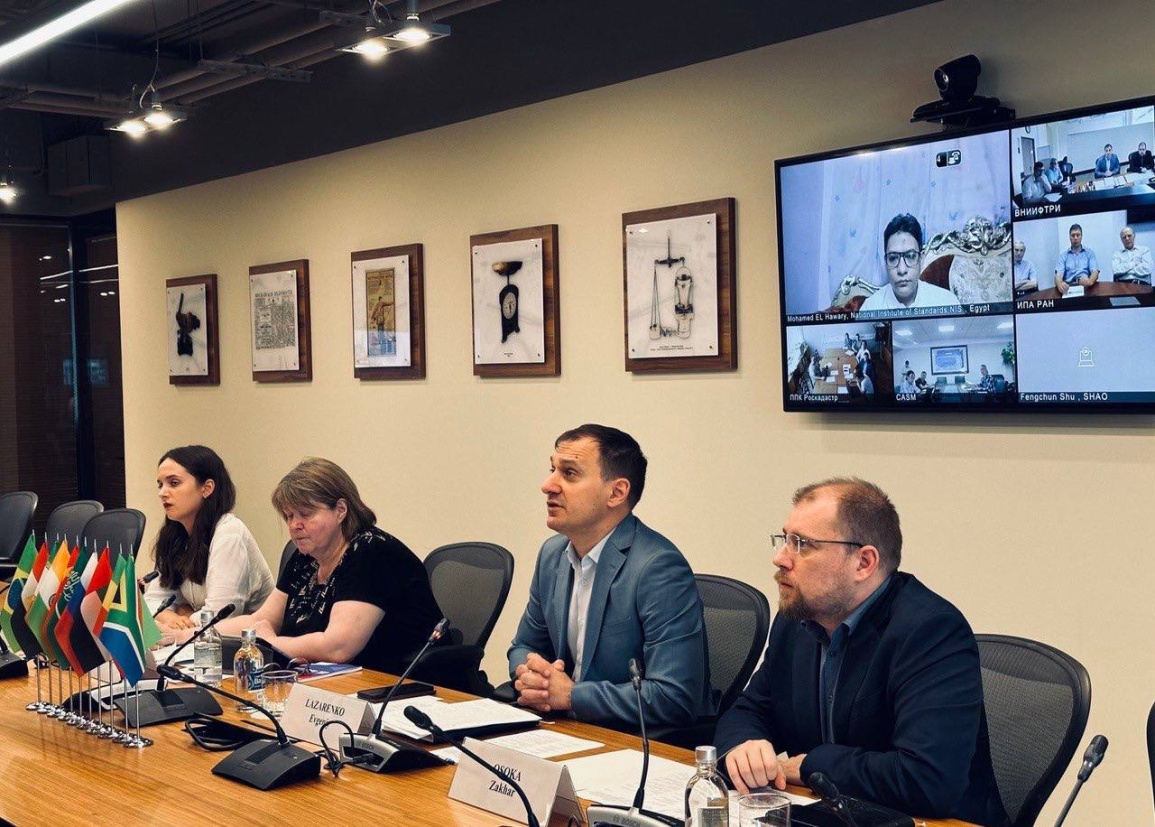
An online seminar was held on 30 May 2024 to discuss the exchange of measurement information from satellite and lunar laser ranging systems, networks of high-precision multi-frequency global navigation satellite system (GNSS) signal receivers, and ultra-long-baseline radio interferometers. The event was attended by representatives of BRICS national metrological organizations, astronomical observatories, and research organizations.
The meeting participants included delegations from Brazil’s Center for Radio Astronomy and Astrophysics (CRAAM) at Mackenzie University and National Institute of Metrology, Standardization, and Industrial Quality Technology (INMETRO), China’s Shanghai Astronomical Observatory (SHAO) and Academy of Surveying and Mapping (CASM), South Africa’s National Research Foundation (NRF), the Time, Frequency, and Microwave Laboratory of Egypt’s Organization for Standardization and Quality (EOS), and the Institute of Ethiopian Standards. The delegation from Russia, which was headed by Deputy Director of the Federal Agency for Technical Regulation and Metrology (Rosstandart) Yevgeny Lazarenko, included representatives of the central office and subordinate agency of the All-Russian Scientific Research Institute for Physical-Engineering and Radiotechnical Metrology, the FSBI Institute of Applied Astronomy of the Russian Academy of Sciences, the Central Research Institute for General Machine Building, and Roscadastre.
“Our job is to develop a strategy for the joint actions of BRICS countries to meet their national needs for various fundamental data based on global and continuous measurements,” Lazarenko said in his welcome address to the seminar participants.
Alexander Fedotov, deputy general director for Rocket and Space Affairs at the All-Russian Scientific Research Institute for Physical-Engineering and Radiotechnical Metrology, made a proposal during his speech to create a BRICS Earth Rotation Service, as well as to form a special BRICS committee to coordinate scientific and technical cooperation in order to guarantee that countries are provided with fundamental data about space and time. For his part, Sergey Pasynok, director of the Institute’s Earth Rotation Parameters Identification Department, told the meeting participants about the operating principles of the International Earth Rotation Service and the Institute’s involvement in its work, as well as the contribution of BRICS countries to the international system for determining the parameters of the Earth’s rotation.
A report titled ‘Rapid identification and forecasting of the Earth’s rotation parameters’ by Natalya Parkhomenko, the leading engineer of the Institute’s Laboratory No. 731, was devoted to the activities of the International Laser Ranging Service (ILRS). During the seminar, Igor Surkis, a laboratory director at the Institute of Applied Astronomy of the Russian Academy of Sciences, spoke about the prospects for unifying the BRICS radio interferometric network for the purposes of coordinate-time support.
Representatives of the Chinese institutions shared their experience in conducting geodetic observations and processing MVMZ-related data in China, and also spoke about a CASM-based platform for geodesy research.
The Rosstandart programme of events as part of Russia’s BRICS chairship envisages 15 in-person and online meetings concerning standardization, metrology, and technical regulation. The central event will be the meeting of the heads of BRICS national standardization bodies in Moscow in July 2024.
The Roscongress Foundation manages the events of Russia’s BRICS chairship.


