- Home
- News
BRICS Academic Forum Opens in Moscow
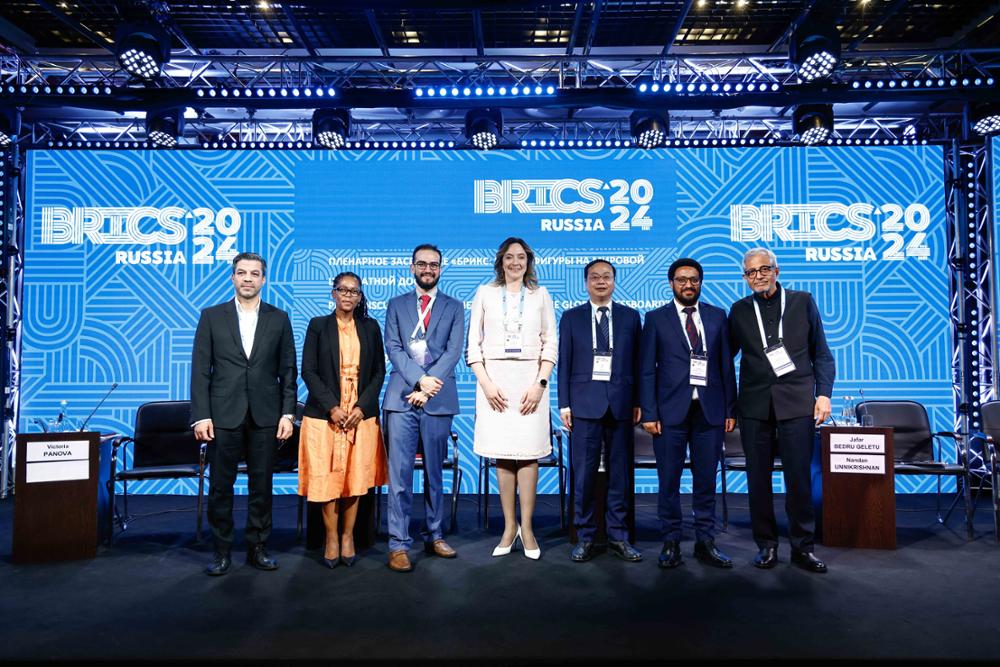
The Academic Forum kicked off on 22 May 2024 under the motto ‘BRICS: New Figures on the Global Chessboard’ and brought together over 200 representatives of the BRICS expert community. Among the speakers at the opening ceremony were Deputy Minister of Foreign Affairs of the Russian Federation and Russia BRICS Sherpa Sergey Ryabkov, Rector of the National Research University Higher School of Economics Nikita Anisimov, First Deputy Chairman of the International Affairs Committee of the State Duma of the Russian Federation and Chairman of the Board of the National Committee on BRICS Research Vyacheslav Nikonov, and Head of the BRICS-Russia Expert Council, Vice-Rector of the National Research University Higher School of Economics, and Russia’s Sherpa in the Women’s G20 Victoria Panova.
Deputy Prime Minister of the Russian Federation Alexey Overchuk welcomed Forum participants, guests, and organizers. He spoke of the important contribution the expert community makes to the development of the BRICS agenda by helping to focus the attention of the BRICS countries on new tasks and challenges and providing a pragmatic approach to their resolution. “It should be noted that many of the initiatives proposed in the past have been approved at the highest level and contributed to the development of BRICS. Today, BRICS wields considerable political clout and enormous economic potential. BRICS countries account for 35.6% of global GDP, 40% of global oil production, about a quarter of global goods exports, and 45% of the world’s population,” he said.
The Deputy Prime Minister also mentioned that more countries were seeking to join the association and that proved the importance of BRICS for global politics and economy. “It is important that BRICS has strong ties to the regions with the greatest potential for economic growth: Africa, Latin America, and South-East Asia. There can be no doubt that BRICS is proving to be the champion of the interests of the Global Majority on the world stage and a truly multipolar structure where the Global South and Northern Eurasia can meet on the principles of equality, sovereignty, and mutual respect. BRICS and BRICS-oriented countries are clearly going to continue to play key roles in the new world order,” Alexey Overchuk said.
“Events like the Academic Forum help shape the future BRICS agenda by fostering academic exchange, strengthening dialogue between the state and the expert community, and developing recommendations for national leaders,” he went on to say in his welcoming address.
Deputy Minister of Foreign Affairs of the Russian Federation and Russia BRICS Sherpa Sergey Ryabkov noted that the association was prioritizing results. “BRICS is a platform where important things are discussed in an informal setting. BRICS is about equal dialogue and collective action. BRICS finds common ground and ways to make our national policies work together without sweeping aside national interests and civilizational diversity, ways to keep moving our constructive agenda forward, to prioritize results,” Ryabkov said, adding how accurately the present forum motto ‘BRICS: New Figures on the Global Chessboard’ reflected the changes taking place right now. Unlike in chess, where the black and white pieces and bipolarity mean many moves are predictable, the emergence of new pieces in a multipolar world creates an exponential number of new opportunities for balancing world politics.
The contribution forum participants make to the expert analysis and content of the work BRICS is doing always receives a great deal of attention from the Ministry of Foreign Affairs and other federal executive authorities in Russia. “I have no doubt the recommendations will be of interest for the relevant agencies and structures throughout BRICS,” Sergey Ryabkov said, wishing everyone a fruitful Academic Forum.
Cultural exchange is a pillar of BRICS activity, and science and education shape the future and contribute to progress. There are many events in the BRICS agenda, but the Academic Forum occupies a special place and is important for everyone, as it has become a place for the best scientific minds in BRICS to come together,” National Research University Higher School of Economics Rector Nikita Anisimov said. “Scientific and educational partnerships can be strategic only if they include interaction between states,” Nikita Anisimov said.
The National Research University Higher School of Economics makes a priority of scientific and expert work, and BRICS is a major part of that. The Rector of the University noted that the BRICS Expert Council was established through the Higher School of Economics to coordinate the expert and public work of BRICS. “We will do everything we can to make BRICS expert work productive. The Forum has proven its effectiveness, and I am confident that it will continue to strengthen ties between experts. I wish everyone success in their work,” Nikita Anisimov said in conclusion.
Head of the BRICS-Russia Expert Council and Vice-Rector of the National Research University Higher School of Economics Victoria Panova noted that expert communities in BRICS started their work even before the first BRIC summit in 2009 and have now been working together successfully for more than 15 years. “The Durban 2013 BRICS Declaration outlined the decision to establish the BRICS Expert Council to coordinate expert work within the association, chart a course for the strategic development of BRICS as a whole, and identify specific initiatives to work on. One such initiative is that of a system of indicators for monitoring performance within BRICS, developed in 2020 to analyze and assess the results achieved and the contribution to the development of each member country,” she said, adding that the various national expert communities will infuse the process with new life and fresh ideas.
Victoria Panova stressed that it was totally unacceptable for scientific and academic cooperation to be politicized and reiterated that the Academic Forum brought together the organization’s leading experts, professors, and researchers – its best minds. This year, experts from new BRICS member states are also participating in the Forum. “The Forum is a platform for equitable, non-discriminatory partnerships. I would like to make it clear that the doors to our expert community remain open to everyone who understands the importance of BRICS as an institution of global governance, who understands the need for international expert dialogue, and who are aware that it is totally unacceptable to politicize scientific and academic cooperation,” Victoria Panova said.
“As a representative of the expert and academic community, I look forward to seeing expert interaction within BRICS become even more productive and successful, both in terms of concrete initiatives for the future of BRICS and contacts between academic communities. I am confident that this BRICS Academic Forum will drive new work in each of these areas,” she said in conclusion.
The BRICS Academic Forum is the main expert event of Russia’s BRICS Chairship and will be taking place in Moscow on 22–24 May. The event is organized by the BRICS Expert Council.
During the forum, participants from around the world make presentations and discuss pressing issues related to the expansion and strengthening of cooperation within BRICS, financial and economic mechanisms, and ways to further develop multilateral cooperation among others.
The Academic Forum will provide recommendations to be prepared by the BRICS Expert Council for the leaders of BRICS member states for the 22–24 October summit in Kazan.
The Roscongress Foundation manages the events of Russia’s BRICS Chairship.


