- Home
- News
“BRICS – Space for Opportunities” Conference Held in Moscow
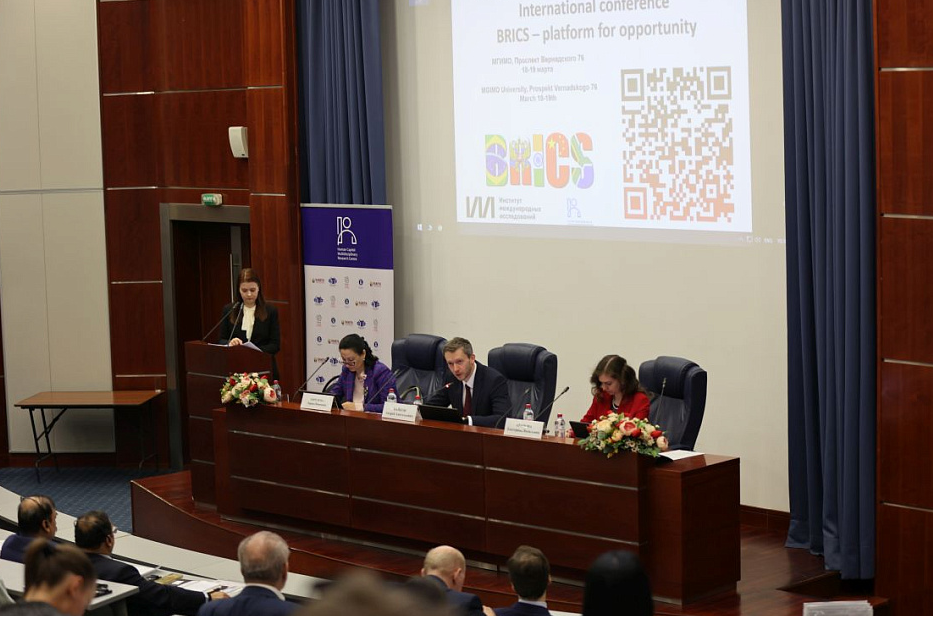
On 18-19 March the MGIMO Centre for Advanced Research on Human Potential and the Institute for International Studies of the MGIMO University hosted the ‘BRICS – Space of Opportunities’ International Conference.
The event was divided into a plenary session and several working sections. MGIMO Vice-Rector for Science and Research Andrey Baykov opened the plenary session, reminding the audience of stages of development of BRICS and underlining its significance in terms of economic, political, and human resources.
RUDN Vice-Rector for International Activity Larissa Efremova welcomed the audience and spoke of the work of BRICS Network University, developmental milestones reached since 2016, and shared plans for 2024 during Russia’s BRICS Chairship. Deputy Director of the Project Office of the Global Centre for Advanced Research on Human Potential E.Arapova stressed the importance of research of human capital for BRICS. Director of the IMI Centre for Scientific Diplomacy and Advanced Academic Initiatives V.Sutyrin spoke about the importance of scientific diplomacy and co-operation between universities.
The conference was attended by representatives of major universities from BRICS countries: Pandit University (India), North-West University (South Africa), Durban University of Technology (South Africa), Jawaharlal Nehru University (India), the Federal University of Rio de Janeiro (Brazil), and Golestan University (Iran).
The event included sections on ‘Global Governance in the Face of Modern Geopolitics’, ‘Security and Development in Africa and the Expansion of BRICS’, ‘Cooperation between Russia and India: Challenges and Opportunities’, ‘Issues Relevant to Deepening Economic Ties between Russia and Brazil’, and ‘BRICS Network University: New Opportunities for Cooperation’.
Attendees of the section dedicated to ‘Global Governance in the Face of Modern Geopolitics’ discussed the economic and political components of global governance. Topics up for consideration included the consolidation of member state financial and legal systems, taxation of the digital economy within BRICS in the context of state tax security, and the sustainability of the system created in BRICS with regard to social development indicators.
The section dedicated to ‘BRICS Network University: Opportunities for Cooperation’ brought together representatives of participating BRICS Network University institutions. The experts discussed the challenges and opportunities that exist for joint educational products.
Foreign colleagues participating in the conference also gave several open lectures for MGIMO students in English.
The Roscongress Foundation manages the events of Russia’s BRICS Chairship.


