- Home
- News
Russian Academy of Sciences Opens Meeting of the Heads of the Academies of Sciences of the BRICS Countries
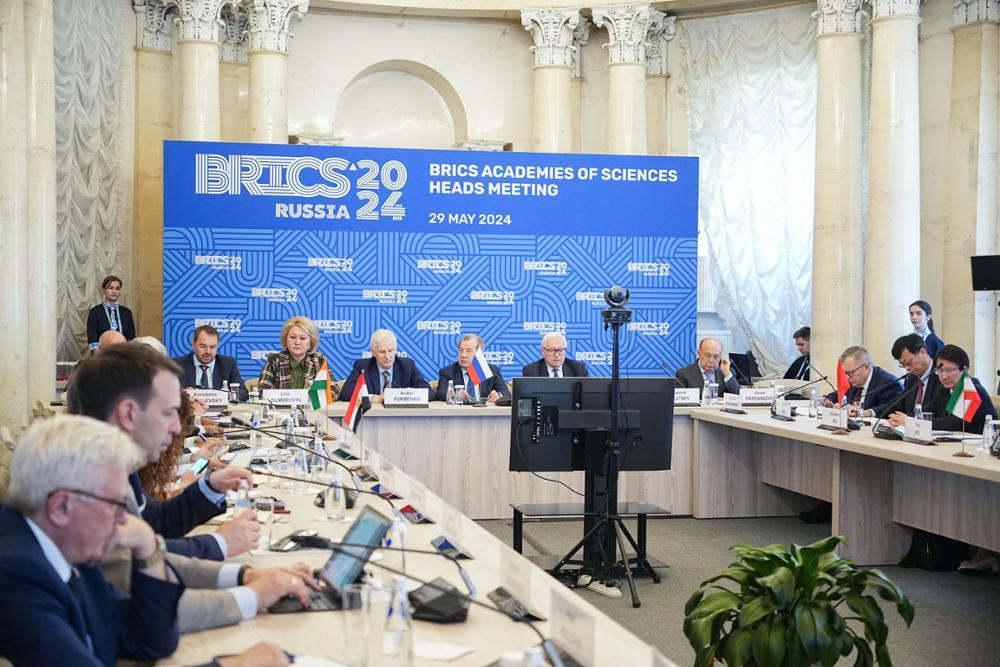
The meeting held on May 29 as part of the programme of events planned for Russia’s Chairship of BRICS in 2024, was dedicated to ‘Academic Partnership in the Interests of Peace, Mutual Development, and Prosperity’. The event was attended by the presidents and vice presidents of the academies of sciences of the BRICS countries, representatives of the Russian academic community, and high-ranking Russian government officials.
“This is the second time that the Russian Academy of Sciences has organized an event as part of Russia’s Chairship of BRICS especially for the academies of sciences. Our countries are keen to develop all areas of cooperation within the BRICS framework. As the heads of our respective national academies of sciences, we are tasked with ensuring the development of scientific cooperation,” the President of the Russian Academy of Sciences Gennady Krasnikov noted in his opening speech.
Krasnikov drew attention to the fact that the forum was being held the same year that the Russian Academy of Sciences would be celebrating its 300th anniversary, an anniversary that was included at the 42nd Session of the UNESCO General Conference in its list of memorable dates.
“Today, the Russian Academy of Sciences includes four territorial branches and 13 regional centres. Its 1900 members are internationally recognized scientists and researchers,” Krasnikov stated in his report on the Academy’s activities.
The opening session was attended by Aide to the President of the Russian Federation Andrei Fursenko, Chair of the Federation Council Committee on Science, Education and Culture Lilia Gumerova, Deputy Minister of Foreign Affairs of the Russian Federation Sergei Ryabkov, Special Representative of the President of the Russian Federation for International Cultural Cooperation Mikhail Shvydkoy, Deputy Minister of Science and Higher Education of the Russian Federation Konstantin Mogilevsky, and Chairman of the State Duma Committee on International Affairs Leonid Slutsky. The event was moderated by Vice President of the Russian Academy of Sciences Vladislav Panchenko.
“Today, science is absolutely crucial not only to the development of countries, but also to their very existence. The global situation that is developing now is not an easy one. We might not always like it, but we understand that science, on the one hand, is an instrument of independence for countries, and, on the other, it is and always will be a space in which countries with different views can exist and interact. Science is the heritage of all mankind,” Andrei Fursenko stressed in his welcoming speech.
“The creation of new projects in fundamental and applied scientific research run jointly by the BRICS countries, and the establishment of high-profile scientific centres for the humanities, represents a synergy of the developments that have been achieved by the academies of sciences of the BRICS countries over the course of many years,” Leonid Slutsky added.
“The theme of this forum – Academic Partnership in the Interests of Peace, Mutual Development, and Prosperity – fully reflects the spirit of the times. It is a reflection of the importance of combining our efforts to solve global problems related to improving the quality of life now and in the future. This is the goal around which all BRICS interactions are built,” said Sergei Ryabkov.
The Deputy Minister of Foreign Affairs of the Russian Federation noted that the key trend in the development of international relations is the transformation of the world order towards the establishment of a more just multipolar system that reflects the cultural and civilizational diversity of the modern world, and by consolidating the intellectual potentials of countries we can restore mutual understanding and strengthen scientific diplomacy. “Science should be international. It should help remove borders and push obstacles aside, and it should work for the benefit of humanity. Restricting access to the results of basic research for political or other reasons is simply unacceptable,” Ryabkov stressed.
Vice President of the Chinese Academy of Sciences Professor Wu Zhaohui noted that BRICS is an important force that shapes the international landscape. The Forum of the Heads of the Academies of Sciences of the BRICS Countries is a platform for academic exchange between research institutes of the association’s member countries. “The responsibility for solving the problems facing society today lies with us,” he added.
Professor Wu Zhaohui also put forward an initiative to create mechanisms for the BRICS academies of sciences to exchange knowledge and technology and develop a collaborative network that would include representatives of the scientific community and industry of the BRICS member countries.
The representatives of the academies of science of India, China, Egypt, and Iran identified “mega-science” projects, research into nature-based technologies, climate change, food security, health care, and cooperation between young scientists among the priority areas of cooperation.
“I am confident that, under Russia’s Chairship, we will be able to develop a roadmap that will allow us to achieve common scientific goals and objectives,” said Professor Ali Akbar Salehi, Vice President of the Academy of Sciences of Iran.
“We may speak different languages, but when it comes to science, all barriers disappear and we all start to speak the language of science,” said Professor Gina El-Feky, President of the Academy of Scientific Research & Technology of Egypt.
“It is important not only to discuss current issues, but also to develop specific steps that we can implement in partnership with each other,” added Professor Ashutosh Sharma, President of the Indian National Science Academy, who also proposed establishing cooperation in the development of environmentally efficient technologies.
At the plenary session, the guests gave presentations on the key areas of activity of their respective academies of sciences. For example, Chinese Academy of Sciences is running an international internship programme allowing scientists from around the world to be a part of the latest developments. The programme was first proposed by the Chairman of the People's Republic of China Xi Jinping.
The scientific discussions, as well as the bulk of the business programme, will take place on 30 May 2024 at the Kurchatov Institute national research centre in Moscow. Members of the foreign delegations will have the opportunity to learn about the research infrastructure of Kurchatov Institute.
The Roscongress Foundation is acting as the operator of events organized as part of Russia’s Chairship of BRICS.


